Artificial Intelligence in the Workplace: Empowering Employees and Enhancing Productivity
6/12/20253 min read
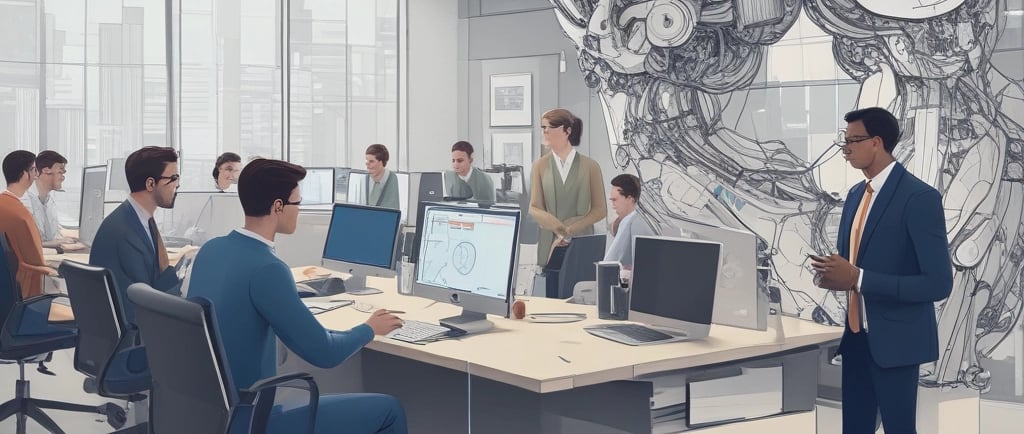
Artificial Intelligence (AI) is no longer a futuristic promise—it is a present-day enabler of business transformation. In today’s digital economy, AI is reshaping industries by augmenting human capabilities, streamlining operations, and unlocking new levels of productivity. Rather than replacing workers, AI is increasingly being deployed to make employees more efficient, accurate, and adaptive—essentially transforming them into "super humans" within their professional domains.
Augmenting Human Intelligence
One of the most compelling applications of AI in the workplace is its ability to enhance cognitive tasks. Natural Language Processing (NLP), for example, powers tools like Microsoft Copilot, Google Duet AI, and OpenAI's ChatGPT Enterprise. These tools assist with summarizing long documents, drafting emails, generating code, and even automating meeting notes. According to a 2023 McKinsey report, generative AI tools have the potential to automate 60-70% of tasks across various roles, especially in knowledge-intensive sectors such as finance, legal, and IT services [1].
At accounting giant PwC, AI tools are integrated into tax and audit workflows to automate routine checks and flag anomalies. Employees no longer spend hours sifting through spreadsheets—instead, they focus on high-value judgment tasks. Similarly, Morgan Stanley deployed OpenAI’s GPT-powered assistant to support its wealth management advisors by giving them instant access to the firm’s research and insights, greatly reducing the time spent on information retrieval [2].
Hyperautomation and Intelligent Process Automation
Hyperautomation—the application of advanced technologies including AI, machine learning (ML), and robotic process automation (RPA)—is enabling organizations to automate end-to-end business processes. Companies like UiPath and Automation Anywhere provide platforms that integrate AI to make bots more intelligent. For instance, AI-enhanced RPA can now interpret unstructured data such as emails or scanned documents, allowing automation of complex workflows in HR, procurement, and customer service.
For example, at Lufthansa Technik, AI-driven bots are used to process thousands of maintenance reports, identify patterns of potential failures, and schedule preventive actions. This not only improves operational efficiency but also empowers maintenance staff with actionable insights they wouldn’t be able to gather manually [3].
AI in Software Development
In software engineering, tools like GitHub Copilot (powered by OpenAI) are significantly reducing development time. Developers receive intelligent code suggestions in real time, often completing entire functions or scripts with minimal input. According to GitHub’s 2023 productivity survey, developers using Copilot reported a 55% increase in coding speed and a reduction in mental effort [4].
Furthermore, AI-powered testing platforms such as Testim and Mabl help automate test case generation, execution, and maintenance, enabling QA teams to focus on strategic testing rather than repetitive validation tasks.
Enhanced Decision-Making with Predictive Analytics
Predictive analytics is another area where AI empowers employees to make better, data-driven decisions. Retailers like Walmart and Target use AI models to forecast demand, optimize inventory, and personalize marketing at scale. These insights help planners and merchandisers respond to market changes with agility.
Challenges and Considerations
Despite the transformative impact, AI integration is not without challenges. Issues such as data privacy, algorithmic bias, and employee resistance require careful attention. Organizations must adopt AI governance frameworks and invest in upskilling initiatives to ensure ethical use and widespread adoption.
Conclusion
AI is not replacing the workforce—it is redefining it. By automating routine tasks, enhancing decision-making, and accelerating complex workflows, AI tools are turning employees into highly capable, data-empowered professionals. As organizations continue to integrate these technologies, the synergy between human creativity and machine intelligence will be the cornerstone of future productivity.
References:
[1] McKinsey & Company. (2023). The economic potential of generative AI: The next productivity frontier. Economic potential of generative AI | McKinsey
[2] CNBC. (2023). Morgan Stanley launches GPT-4-powered assistant for financial advisors. Morgan Stanley uses ChatGPT to help financial advisors
[3] Lufthansa Technik. (2024). AI for aircraft maintenance optimization. Lufthansa Technik brings artificial intelligence to MRO |
[4] GitHub. (2025). GitHub Copilot: AI that builds with you. GitHub Copilot · Your AI pair programmer
Disclosure: This post was generated with the help of Chat-GPT4 (Jun 11, 2025)